


Current Issues
Case Report
A rare case of acute uterine prolapse in pregnancy, presenting in preterm labour – a case report
1Associate professor, 2Post Graduate, 3Professor, 4Professor and Head, Department of Gynaecology and Obstetrics, Kamineni Institute of medical sciences, Narketpally, Nalgonda, Telangana State, India
ABSTRACT
Uterine prolapse in pregnancy is a rare occurrence in modern obstetrics. Though rare, occurs in early pregnancy and are managed conservatively. This is the first case which presented as acute prolapse in third trimester, in labour and associated with complications, severe anaemia, preterm premature rupture of membranes, oligohydramnios, breech presentation, and with oedematous and inflamed cervix outside the vagina. Emergency lower segment caesarean section(LSCS) was done, intraoperative and postoperative period were uneventful with good maternal and neonatal outcome.
Key words :Uterine prolapse, preterm, premature rupture of membranes, oligohydramnios.
Introduction:
Uterine prolapse in pregnancy is a rare condition. Less than 300 cases have been reported in literature. Incidence in pregnancy is estimated to be 1 in 10,000 to 1 in 15,000 deliveries.1 Although rare there is still a need for obstetrician to be aware of the management of prolapse in pregnancy .Currently there are no clear guidelines for management of prolapse in pregnancy. It is hypothesised that, descent of uterus is initially associated with prolongation of cervix followed by descent of the body of the uterus.2 Conservative management with close follow up and bed rest can alleviate clinical symptoms and reduce potential complication.3 Resolution of the prolapse in later weeks of pregnancy is expected as there is increase in the uterine volume which helps to sit on the pelvic brim.
Case report
A 25 year old Gravida 4, Para 3, Live 2, Death1 with 8 months amenorrhoea came to the OBG OPD, with the complaints of mass per vagina since 5 hours, leaking per vagina and labour pains since 4 hours. on examination, she was conscious and coherent, short statured, and poorly nourished on examination. She was extremely pale, vitals stable, obstetric examination revealed uterine height 30 -32 weeks of gestational age, breech presentation, oligohydramnios. On local examination cervix was seen completely outside the introitus, oedematous, congested, hypertrophied, bleeds on touch with active leak present, per vaginal examination; cervix 2-3 cm dilated, membranes absent presenting part high up.
Treatment with IV antibiotics were started, severe anaemia was corrected using packed cell transfusions, glycerine and magnesium sulphate pack was applied on the cervix lying outside the vagina, After 4 hours, oedema of the cervix subsided and cervix was reposited back into the vagina. Emergency LSCS was done and an alive female baby of weight 1.6 kg was delivered with an APGAR score of 8, 9 at first and fifth minute respectively. Intraoperative and postoperative period was uneventful.
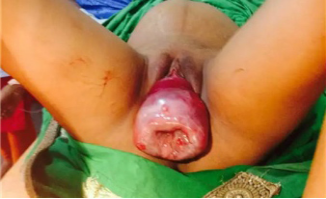
Fig. 1: Pregnancy with third degree uterovaginal prolapse in preterm labour
Discussion
Uterine prolapse in pregnancy may present with wide range of clinical features, pelvic pressure, lower back pain, urinary tract symptoms (acute retention, incontinence), cervical inflammations and cervical mucosal ulcerations. Similarly, complications reported also range from mild discomfort, cervical dessication and ulceration, urinary tract infection, acute urinary retention to miscarriage and even maternal death.4
The management of prolapse depends on the stage, its evolution and on the gestational age. Combine local antiseptics, rest and manual reduction of the prolapse using a pessary to prevent ulceration of the cervix.8 After reduction is accomplished, authors such as Sawyer.6 and Piver & Spezia.5 recommend placement of a well- fitting lever or doughnut pessary, which will often allow the patient to continue the pregnancy without much trouble.
table. 1: Use of various vaginal pessaries to treat uterine prolapsed during pregnancy
| Author & year | Pessary used | Indication | How it works | Comments |
| Piver and Spezia5 1968 |
Doughnut pessary |
Second and third degree utero vaginal prolapse |
It is inflated by a bulb and valve assembly and occludes upper vagina to support uterine prolapse Protects cervix from local trauma of protrusion |
Restored prolapse. Recommended that large doughnut should be inserted & left in place until the onset of labour. |
| Sawyer6 2000 Daskalakis4 2007 | Lever pessary (Hodge) | Mild uterine prolapse with retroversion |
Broad anterior limb of pessary prevents it from turning and precludes pressure on urethra |
Restored prolapse. largest lever pessary should be fixed and left in place until the onset of labour |
| Yogev1 2001 | Ring pessary | First and second degree uterine prolapse |
Fitted into posterior fornix and supports displaced uterus |
Fell out after a few days of bearing in the patients |
| Y Ng, A Paramasivan7 2009 |
Gell horn pessary |
Second or third degree uterine prolapse |
Concave surface of sits 900 to the vaginal axis, either the cervix or vaginal vault Stem prevents turning the support within Vagina, so able to keep even large prolapse in place by means of a comparatively small size pessary Exerts suction effect that helps pessary retention |
Requires a capacious vagina so that the base is broad enough to rest above levators |
Most of the women set in labour and deliver normally, however affected women may be at risk of cervical dystocia during labour that may necessitate intervention during labour.9 Duhrssen’s incision on the cervix can be tried where there is no inflammation of the cervix. Three sites for surgical incisions of an incompletely dilated cervix corresponding to roughly 2, 6,10’ clock position to facilitate delivery.10
Two successful natural pregnancies in a patient with severe uterine prolapse was reported in Finland by Davide D et al, in which they observed resolution of the prolapse during final period of gestation (>24 weeks) followed by a normal vaginal delivery.11
Eddib A et al from USA, presented a case of successful pregnancy in a 44 year old patient with pre-existing uterine procedentia, who reported at 15 weeks with unplanned pregnancy, prolapse persisted up to 30 weeks, she was managed conservatively, with bed rest, local treatment of dessicated cervix with emollients. She had uncomplicated vaginal delivery and later underwent vaginal hysterectomy with anterior, posterior repair and sacrospinal ligament fixation after few months.12 Table. 1 shows use of various vaginal pessaries to treat uterine prolapse during pregnancy.
Conclusion
Recommendations regarding the management of this infrequent but potentially harmful condition are scarce and outdated. While early recognition and appropriate prenatal management of uterine prolapse during pregnancy is imperative, implementation of conservative treatment modalities throughout pregnancy, these applied in accordance with the severity of uterine prolapse and the patients preference may be sufficient to achieve uneventful pregnancy. When considering the mode of delivery spontaneous delivery or a planned LSCS, obstetricians should look out for cervical inflammation and oedema which may complicate an otherwise normal vaginal delivery.
References
- Yogev Y, Horowitz ER, Ben-Haroush A, Kaplan B. Uterine cervical elongation and prolapse during pregnancy: an old unsolved problem. Clin Exp Obstet Gynecol 2003; 30(4): 183-5
- Partsinevelos GA, Mesogitis S, Papantoniou N, Antsaklis A. Uterine prolapse in pregnancy: a rare condition an obstetrician should be familiar with. FetalDiagnTher 2008; 24(3):296-8
- JengCJ,Lou CN, Lee FK ,,Tgeng CR;Successful Pregnancy in Patient with Initial Procedentia Uteri; Acta Obstet Gynecol Scand.2006;501-512.
- Daskalakis G, Lymberopoulos E, Anastasakis E, Kalmantis K, Athanasaki A, Manoli A, Antsaklis A. Uterine Prolapse complicating pregnancy. Arch GynecolObstet 2007 Oct; 276(4):391-2
- Piver MS, Spezia J. Uterine prolapse during pregnancy. ObstetGynecol 1968;32:765-9
- Sawyer D, Frey K. Cervical Prolapse During Pregnancy. J Am Board Fam Pract 1999 13(3):216-218.
- Y Ng, A Paramasivan, A Ahmed. Uterine prolapse in pregnancy: a case report and review of literature. The Internet Journal of Gynecology and Obstetrics. 2009 Volume 13 Number 2.
- Pizzoferrato AC ,Bui C ,Fauconnier A, Bader G, Advanced uterine prolapse during pregnancy prenatal and postnatal management :Gynecol Obstet Ferti 2013 July,Aug:41(7- 8):467-70l
- TsikourasP,Dafopoulos A ,Vrachnis N, Uterine prolapse in pregnancy, risk factors, complications and management. Journal of maternal, fetal , neonatal medicine 2014 Feb;27(3):297-302
- Kiran Pandey, Sangeeta Arya , Shefali Pandey ,Pregnancy with uterine prolapse: Duhrssen’s Incision still valid in today’s scenario ?, International journal of reproduction, contraception, obstetrics and gynaecology, 2013 ;2(4) :586-597
- Davide De Vita, GiordanoS, Journal of medical case reports 2011 Sep14 ;5:459
- EddibA ,Allaf M B, Lele A, Pregnancy in women with uterine procedentia: a case report, Journal of Reproductive Medicine 2010. Jan-Feb; 55(1-2): 67-70.